People usually think only muscle grows; bone growth never crosses their minds. If anything, it feels as though bone is an organ that just degenerates once you reach adulthood. But bone grows too.
What's interesting about bone growth, though, is that the structure gets optimized as well. When we hear "growth," we often think only of growth in quantity — the way muscle growth mainly brings to mind hypertrophy, an increase in muscle mass. When bone is loaded, its structure changes to match that load, and this is what's known as Wolff's law.
Wolff's Law
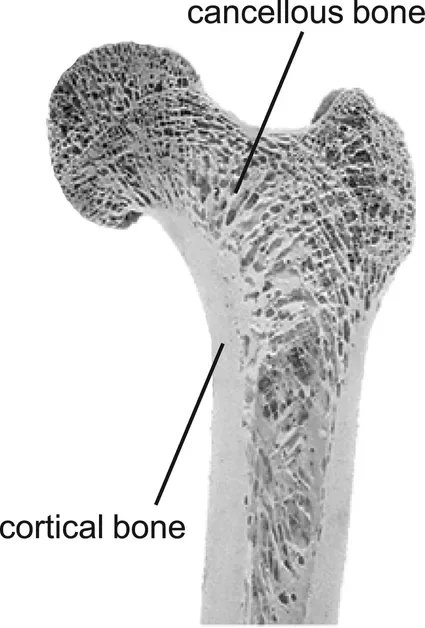
Wolff's law is a theory formulated by the German physician Julius Wolff: bone adapts to the loads placed on it. Bone is, to use a colloquialism, "crispy outside, soft inside" (...). It consists of high-density cortical bone on the outside and relatively low-density cancellous bone (also called trabecular bone) on the inside. 겉바속촉 구조는 같은 질량 대비 높은 굽힘 강성을 보유한 좋은 구조다.
So when loads that stop short of causing a fracture (microfractures included) are applied continuously, the cortical bone thickens and the cancellous bone's structure changes to support that load better. As you can see in the photo above, the trabeculae aren't connected at random — they show a distinct pattern, crossing each other in the central region, for instance. This is called the bone remodeling process.
More bone isn't simply better. For one thing, the energy cost of maintaining it is high — for our species, surviving an ice age was a bigger problem than getting hurt or dying from a broken bone. And bone density becoming extremely high is a disease in its own right, called osteosclerosis. In that case bone can actually break more easily, because the cancellous bone can no longer absorb shock the way a sponge does. As always, everything comes with a trade-off.
By the same logic, if no load is placed on bone, its density falls and its structure thins out. Go unloaded for long enough and the structure can even break apart — and because that is degenerative, there's no recovering it. This is the problem that shows up in astronauts who spend long stretches away from gravity's reach. 1 Why degenerative? Because a severed strut no longer transmits load, so no amount of exercise afterward can restore that structure. It's also why osteoporosis is such a frightening degenerative disease.
Bone, in other words, is a textbook use-it-or-lose-it organ. Which is why you need to exercise appropriately from an early age and look after your bones.