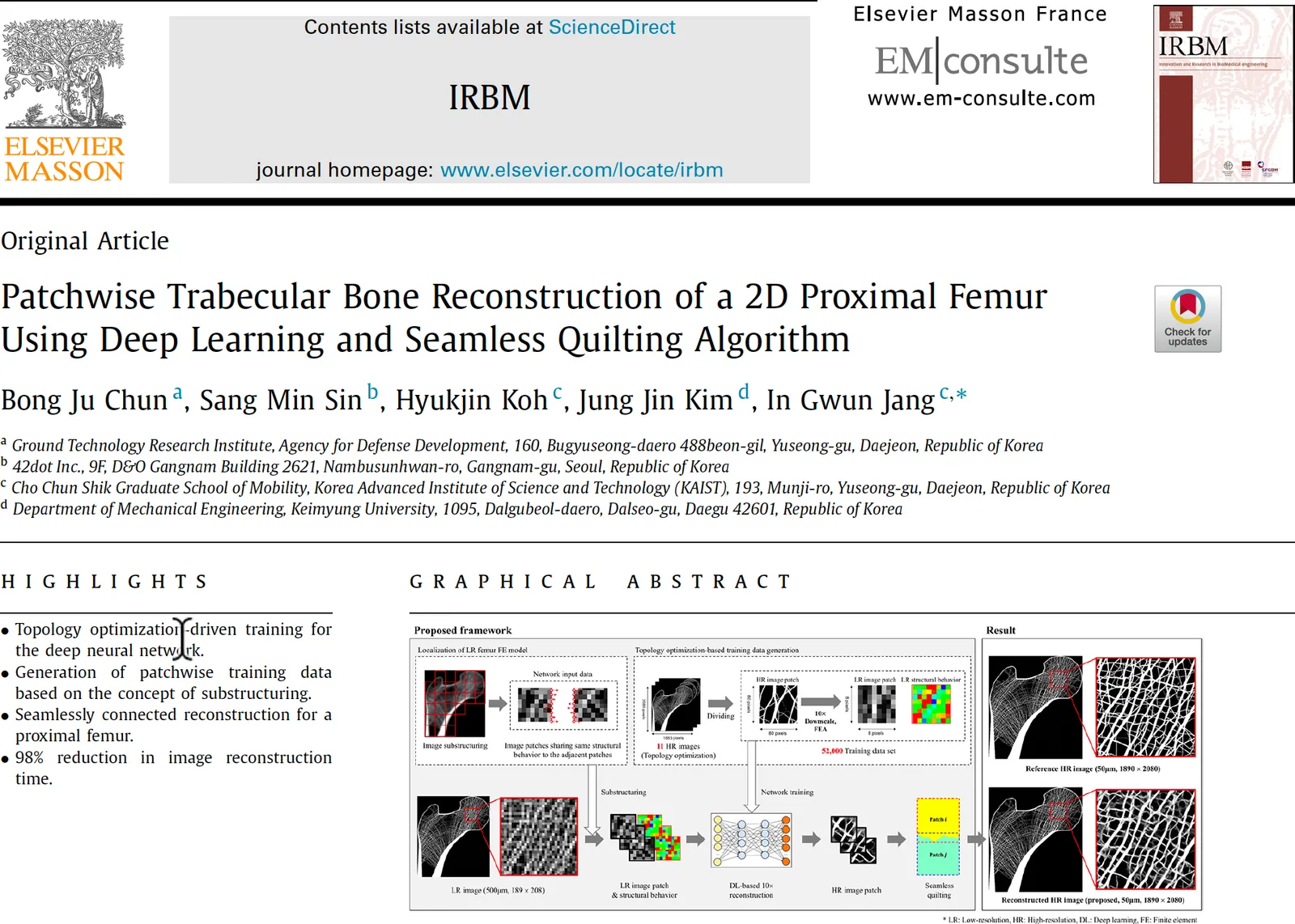
Five years after finishing grad school, my master's thesis has been published in an academic journal.
I'm grateful to the senior and junior colleagues who wrote it up as first authors. Grateful to my advisor too. They didn't leave my name off — they put me in as second author. I'm someone who left academia, so being listed as an author doesn't really do anything for me, and yet they honored research ethics and included me anyway. Most grad students have nothing good to say about their lab after they graduate, but ours really was a good one.
The research is about super-resolving two-dimensional synthetic femur images. Well... I used the deep learning models that were popular at the time, like ResNet and SRGAN, plus an existing imaging algorithm, the quilting algorithm — I threw in every combination under the sun. The absolute peak of flailing around just to graduate, basically. Anyway, to think that master's thesis became an SCI paper. I'm the one who came up with the methodology and even I had no expectations. My advisor and the people in the lab are impressive.
During my master's I worked with femurs a lot. Not just two-dimensional images, but actual CT femur scans as well. The CT scan problem is interesting too — you take two-dimensional images from multiple angles and reconstruct them into three dimensions. I even won an award from the Korean Society of Mechanical Engineers for work on the CT scan problem.
And yet
And yet, after all that research, I never took care of my own hip mobility. My hips are still incredibly stiff. For me, things like the femur and the hip joint weren't really parts of an actual body — they were more like virtual objects in my head.
The more interesting part was something else. First, the femur has three landmarks: (1) the femoral head, (2) the greater trochanter, (3) the lesser trochanter.
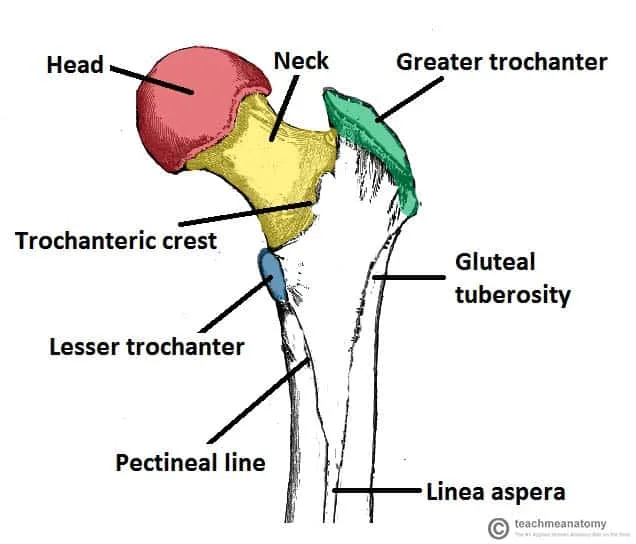
But it was only recently that I figured out where the actual greater trochanter and lesser trochanter are on my own body. The greater trochanter can be palpated. Press your hand against the outside of your pelvis and rotate your leg inward and outward — you'll feel a bone, and that's the greater trochanter.
I studied and worked with all of this, and yet I never connected it to my own reality. For two years I didn't know exactly where it was on my body. In my head, sure, I knew. But being able to close my eyes, feel around with my hand and go "ah, it's about here" — that only came to me now. And it isn't even that hard.
If you can't connect it to reality, you haven't really learned it. Of course the process of learning can have its own meaning, but once you're into your thirties, that stops being an excuse. These days, whenever I learn something, I keep asking myself how I'll actually put it to use in real life. I can't keep repeating the mistakes I made before.