I've made a lot of noise about how a Zettelkasten lowers the difficulty of writing, but writing is still hard. Having the raw material only makes it easier to get started and to structure what you're saying — writing the details is still hard, I think. Because you have to make the content persuasive and give it some flavor.
I've felt the psychology of getting stuck mid-writing many times. I felt it especially painfully while writing my master's thesis. When your writing stalls, anxiety sets in. You clamp your mouth shut. You end up staring a hole through the monitor. Your hands freeze over the keyboard, tapping at the keys. You get bored, frustration creeps in, and you open Instagram. I imagine plenty of you have felt this too, not just me.
Abroad, this phenomenon is called writer's block. To solve writer's block, I read all sorts of articles and ran experiments. What I found was that the vast majority of the methods rest on one shared principle.
That principle is: "remove constraints during divergence." Knowledge work consists of diverging and then converging. Removing constraints during divergence is a principle worth applying to all knowledge work. The classic example is the ban on criticism during the idea-gathering stage of brainstorming. Collecting fleeting notes in the Zettelkasten workflow, or the Inbox in GTD — these all exist to remove constraints during divergence so that gathering thoughts and material flows smoothly. If you want to know more about this, see the video below.
The same goes for writing. Writing, too, splits into a divergence stage and a convergence stage. Usually, when you get stuck writing, it's because you're unknowingly imposing constraints during the divergence stage, where you should be building up volume. You can't write because you're censoring yourself. Apply the "remove constraints during divergence" principle and writing gets a little easier.
The principle is one, but there are many ways to implement it. From here, I'll introduce methods based on "removing constraints during divergence." They'll probably help you right away.
1. Force yourself to write anything at all
You can think of this as a kind of warm-up. Just write, wildly. It can be the piece you're supposed to be writing, or you can jot down whatever comes to mind, exactly as it comes. Forcing yourself to write down your thoughts as they come gives you the feeling of your head warming up, and then the writing comes.
You can also use tools. The Word Sprints site (https://wordsprints.org/) pushes you to write as many words as possible within a limited time. On Word Sprints, you can set yourself the goal of writing as much of your own piece as you can inside the time limit.
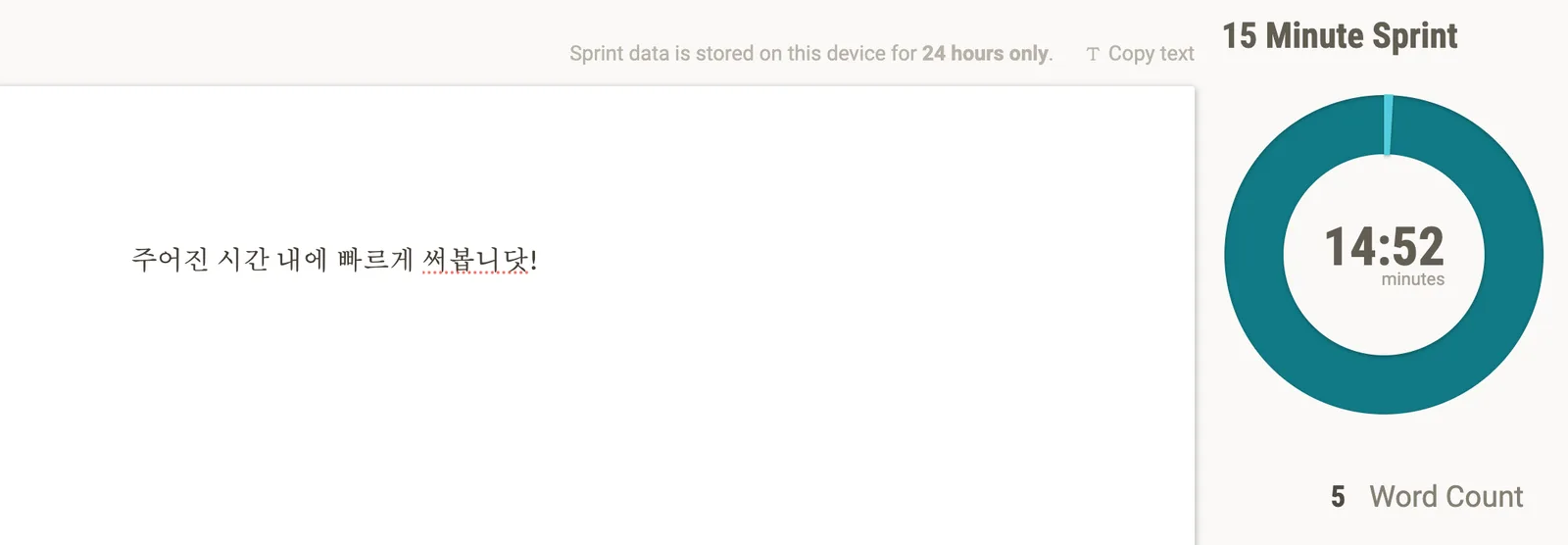
Word Sprints
Or you can try a forced-writing site like this one (https://writing.moistmarketer.com/). This site is pretty fun. You describe a given image in as much detail as you can, and if you stop writing for five seconds, your text starts getting erased bit by bit (!). To keep it from being erased, you have to squeeze out some next word within five seconds. You'll feel like a human ChatGPT. I used this site for about two weeks, and I could feel the number of words I wrote within the time limit going up day by day.

Forced-writing site
2. Write as if you were talking
This may just be a personal impression, but when I say something out loud, the writing comes a little more easily. For expository writing especially, it gets much smoother if you imagine someone sitting in front of you and write with the feeling of explaining it to that person. It feels like there are fewer constraints on speaking than on writing. Slips of the tongue exist, but slips of the pen don't, you know? It's easier to be careless when speaking than when writing.
Writing with the feeling of explaining it to someone doesn't just increase your volume — it can also surface gaps you never expected. You're speaking in order to persuade or explain to this person, and that's when you notice the leaps in logic or the missing explanations.
3. Breaking the order | Writing in whatever order it comes to you
I gave it the grand title of "breaking the order." Instead of writing the piece in order, you write whichever part comes to mind first. In other words, you've removed the constraint of writing order. There's no need to go straight from introduction to conclusion — if the conclusion comes to you vividly, write the conclusion first.
If you start from whatever part comes to mind and build up the overall volume of the piece, the "I have to write this" anxiety will ease a bit too. Because there's now something on the page, and you're much closer to done. And when the anxiety drops, you come out of tunnel vision and the writing gets easier.
I introduced three methods, but they all rest on a single principle. Once you know the underlying principle behind productivity techniques like these, you can apply it in other situations. Or you can keep only the core of a methodology and twist the rest a little.