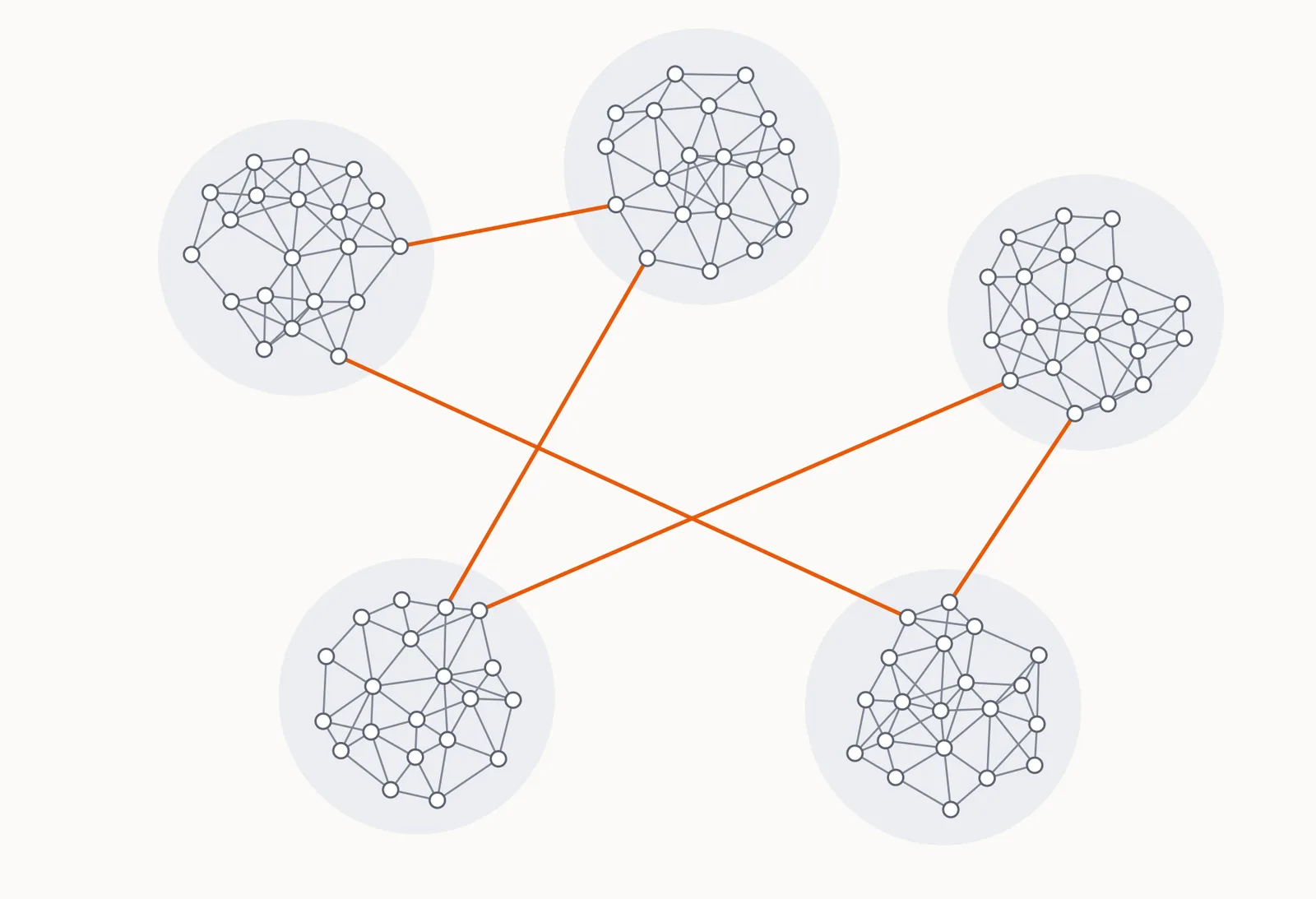
You strike up a conversation with someone you've just met, and the two of you follow each other on Instagram. Then you find out that their friend is your friend. Every time that happens, we feel what a small world it is. There's even a theory that anyone can be connected to anyone else in just six steps.1 Perhaps I could reach Donald Trump in six steps or fewer. A relationship that makes the world feel so small: a network. This kind of network is called a small world network.
A small world network has the following two characteristics. They can be defined mathematically, but this piece doesn't get into the math.
- Clustering: The nodes in the network are clumped together. For example, my friends are likely to be friends with one another.
- Short path length: Few steps are needed to connect any two nodes. For example, you can get from one to another in just a few hops.
In other words, as in the picture above, there are many clusters, and you can quickly get from any cluster to any other. If a network has only one of these two traits, it turns out strange. For example, with clustering alone, each cluster ends up isolated. And with random connections but no clusters, you get chaos with no structure at all. Only when clumping and connection exist together do you get a small world network.
Examples of Small World Networks
Many networks have the characteristics of a small world network. Here are a few examples.
Facebook. In 2016, a Facebook research team analyzed about 1.6 billion users and found that, on average, any two were connected within just 3.57 steps.2
Actors, power grids, and C. elegans. In their paper, Watts and Strogatz showed that the co-starring network of Hollywood actors, the power grid of the western United States, and the neural network of the nematode C. elegans all have a small world structure. 3
The brain. In the brain, too, regions clustered by function are densely connected internally. And a small number of long-range nerve bundles are said to link distant regions.4
Advantages of Small World Networks
So why do so many networks take on a small world structure? What advantages does it have?
The first is speed. After just a few steps, you can reach anywhere. Watts and Strogatz's paper also noted that signals travel faster and that epidemics spread far more easily than in a regular lattice. 3
The second is cost. For example, connecting every node to every other would give the fastest transmission, but the cost of connections rises accordingly. A small world network connects only nearby nodes and keeps just a few long-range paths, yet its paths are still short. It is said that the brain, too, probably evolved this structure to be efficient, since building and maintaining nerve bundles takes energy. 4
So how can we put small world networks to use?
Small World Networks in PKM
PKM, which connects notes, is ultimately a network too. A good network of notes will have the characteristics of a small world network.
For example, if you organize notes only top-down, you'll end up with a network of clusters alone. Notes are neatly arranged by topic, but notes from different topics never meet. It would be hard to discover insights that cut across fields. You can dig deep, but your reach is narrow.
Conversely, if you connect notes bottom-up, purely as things occur to you, you get a random network with no clusters. You may get insights that cut across fields, but each field is thin. In other words, you end up digging thin and wide.
So you have to move back and forth between the two: top-down and bottom-up at the same time. Mapped onto the two characteristics of a small world network, it would look like this:
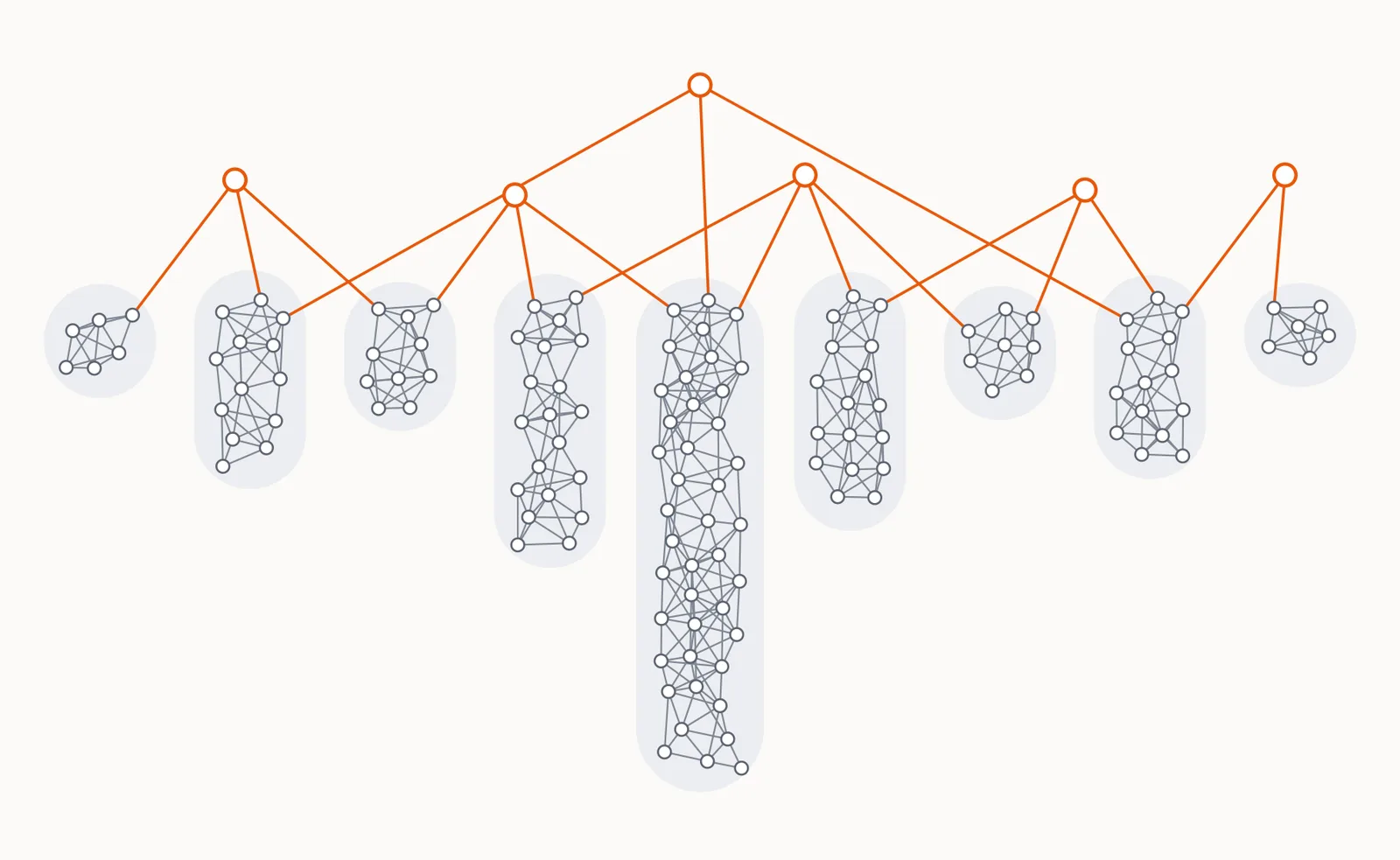
- Clustering -> Hub notes (MOC, Index): A note that holds many notes on a single topic, where you dig deep into that topic. The hub note described in Zettelkasten: A Framework for Writing More and Thinking More plays this role.
- Short path length -> Bridge notes: Notes that connect different topics. Meta-concepts that apply across many fields, such as Mental Models, take on this role. Since such notes are linked all over the place, they can also serve as hub notes in their own right.
Perhaps the knowledge graph of a T-shaped person looks something like this: some area dug deep, plus mental models that cut across many fields.
Footnotes
-
 Three and a half degrees of separation, Facebook Research, 2016. ↩
 -
Watts, D. J., & Strogatz, S. H. (1998).
 Collective dynamics of 'small-world' networks. Nature, 393, 440–442. ↩ ↩2
 -
Bassett, D. S., & Bullmore, E. (2006).
 Small-world brain networks. The Neuroscientist, 12(6), 512–523. ↩ ↩2
 Six Degrees of Kevin Bacon - Wikipedia