Writing is at the heart of thinking. Unless you're content to pat yourself on the back and declare "I was right all along," you need to be able to express your thoughts and develop them through what you write. Everyone knows writing matters, and plenty of people care about it.
So how do you build writing skill? In the end, isn't it about reading a lot, writing a lot, and thinking a lot? This is the well-known trio: read widely, write often, think deeply. Of these, reading widely is the one people have trained the most. The importance of reading gets drilled into us from childhood, so most of us practiced it semi-involuntarily — partly because it mattered for college entrance exams. Reading methods are still a popular self-improvement topic, and "I read over 100 books this year" is a standard humblebrag. Anyone can read a lot if they set their mind to it.

The problem is writing often and thinking deeply. There's no famous methodology or training regimen for either. They're also hard to quantify the way "100 books a year" is, so you never really know if you're doing well. That got me thinking about what a framework for writing a lot and thinking a lot might look like. Writing and thinking a lot means thinking and writing regardless of the occasion, right? Which means you have to write down whatever crosses your mind for as long as you're awake. We usually call that note-taking.
In other words, a framework for writing a lot and thinking a lot is probably a framework built around notes. And it can't stop at just jotting things down — you also need a process for fleshing those notes out and connecting them to one another. Otherwise how would your thinking develop, or insight emerge? Following that thread led me straight to the Zettelkasten I'm introducing today.
It's a method where you take notes on your own thoughts and other people's thoughts as you go, connect them, gather raw material bottom-up, and then discover a topic later and write. It's the opposite of the top-down approach school taught us — pick a topic, then outline, then paragraphs, then sentences.
What does Zettelkasten actually improve?
First, it lightens the burden of writing. Normally we write top-down: settle on a topic, build an outline, structure the paragraphs, compose the sentences. The problem is that writing this way often means the writing doesn't come. Ideas just don't show up. Choosing a topic is a headache, building an outline is hard, and coming up with paragraphs that support the topic is fiddly.
Zettelkasten gathers raw material bottom-up. You only settle on a topic once you've accumulated enough insight and material, which reduces the burden at the moment you sit down to write. If there's a fixed amount of pain that writing entails, you're spreading it out. And since you already have a decent stock of material and paragraphs, writing becomes a matter of assembling what you have and then filling in and revising the gaps. That's noticeably lighter than starting from a blank page.
Second, using Zettelkasten is itself good writing practice. Zettelkasten demands a lot of writing in the form of notes. Writing a lot is essential to writing well, and using Zettelkasten means you're writing a lot. You end up producing quite a few notes.
Finally, Zettelkasten is fun. There's real pleasure in writing notes without pressure, and in connecting them. The serendipity of stumbling onto an unexpected insight while linking things up feels great. And these days AI can even connect similar notes for you, which is its own kind of delight. Writing and linking notes over a beer after work is genuinely enjoyable.
Types of notes
Zettelkasten has three kinds of notes: fleeting notes, where you quickly jot down your own thoughts; literature notes, where you record other people's thoughts; and permanent notes, where you write out a thought in complete form so you can use it in your writing later.
Fleeting notes

A fleeting note is a note you write the instant a thought occurs to you in daily life. It doesn't need to be tidy — just enough that you'll remember later what it was about. It's temporary storage before the thought becomes a permanent note. Immediacy is what matters here. If capturing a thought requires booting up your computer and sitting down, the thought may well evaporate in the meantime. Use an app that's great for quick capture, like Apple Notes or Google Keep, or go analog. KakaoTalk's "send to myself" is an excellent scratch space too. Fleeting notes either become permanent notes later or get thrown away.
Literature notes
A literature note is a collection of the parts that inspired you as you took in someone else's thinking — a book, a YouTube video, whatever. Rather than copy-pasting verbatim, it's generally better to put it in your own words; it sticks in memory better. That said, there's no need to go overboard — a brief summary of the content is enough. And always cite the source, of course.
Permanent notes
A permanent note is a note that captures a thought in complete form so you can use it in your writing later. Look through your fleeting notes, literature notes, and permanent notes, pick out what connects to your own thinking or interests, and write it out completely enough that anyone reading it would understand. Each permanent note should record exactly one thought. That's what keeps thoughts separated note by note, which is what makes it possible to connect them and discover insight.
Once you've written the thought out in complete form, consider which of your existing literature notes or permanent notes it might connect to. In the act of attempting connections, an unexpected link can surface a new insight. You're artificially imitating creative thinking, in a sense. It brings to mind Steve Jobs's "connecting the dots." Linking also makes it easy to pull all the related notes at once when you sit down to write later. In the analog era this linking work was a major problem, but in the digital era we have links, so it isn't hard. There are even apps like Obsidian specialized in connecting notes.
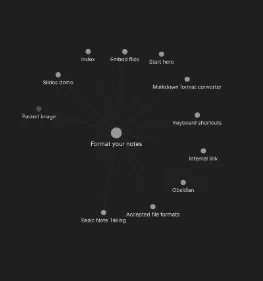
As for how to connect: (1) work from memory, (2) find notes through a graph or index, or (3) use semantic search like QMD to surface notes with similar meaning.
"Connection" also gives rise to hub notes among your permanent notes. A hub note is a note that links many other notes together. It's usually the keyword for whatever topic you're currently digging into. If you're deep in Zettelkasten, your "Zettelkasten" note becomes a hub note. And among your hub notes, the one you're interested in right now becomes an entry point. That entry point is what you use to enter the "reading" phase of your notes.
The Zettelkasten process
Zettelkasten isn't just the surface-level notion of linking notes in an app like Obsidian. It's a bottom-up writing framework for producing output. Let me walk through the process from idea generation all the way to the finished piece.
1. Create fleeting notes
When an idea strikes you in daily life, jot it down fast and leave it as a fleeting note. I recommend an app like Google Keep. Put it on your home screen as a widget and you can capture a thought quickly any time.
2. Create literature notes
If something you read, watch, or listen to contains an idea that inspires you, put that idea in your own words as a literature note. Cite the source and file it in your literature note collection. Whatever reading notes or YouTube summary notes you already keep are literature notes.
3. Create permanent notes
You write permanent notes while looking at fleeting notes, literature notes, or existing permanent notes. Write them as if you're producing a paragraph you'll use in a piece later.
3-1. Writing permanent notes from fleeting notes
Fleeting notes pile up at all hours, so it's best to check them regularly, move them into permanent notes, and delete every fleeting note. Every other day I open Google Keep and Apple Notes and clear them out entirely, migrating everything into permanent notes.
3-2. Writing permanent notes from literature notes
When a thought of your own surfaces while reviewing a literature note, turn it into a permanent note. And link that permanent note back to the literature note — that's how you credit where the idea came from. I don't do this on a schedule; I do it when I'm digging deep into a topic and working through a lot of material.
3-3. Writing permanent notes from permanent notes
Starting from the entry point for whatever topic currently interests you, read through your permanent notes and write new ones. Revisiting them after some time has passed will surface different ideas or different connections. "Permanent" doesn't mean existing permanent notes can't be edited. If there's something to add, add it.
4. Produce output once you have enough
As I said earlier, Zettelkasten is a framework for output. You can't just keep writing notes forever. Once you have enough of them, you'll have your own distinctive insight, a topic will have taken shape, and the paragraphs that fit that topic will have accumulated. Stitch them loosely together and start writing.
Things to keep in mind when using Zettelkasten
The Zettelkasten process itself is extremely simple. But it can get very confusing in practice. That's why there's so much noise around Zettelkasten methodology. Here I'll go over what I think you should know going in.
Zettelkasten is less efficient than conventional top-down writing
A bottom-up approach like Zettelkasten can be less efficient than a well-designed top-down one. With clear goals and clear methods, top-down gets you the result you want quickly. Zettelkasten isn't a great fit for, say, a one-blog-post-a-day book review challenge. It's true that Zettelkasten reduces the burden of writing, but it won't make you more efficient at an assignment due tomorrow or writing you owe at work. It's effective over the long run, when you're writing pieces that carry your own insight. That's when having gathered a lot of notes bottom-up pays off.
If it isn't fun, don't do it
Zettelkasten shouldn't be a grind. The process has no immediate goal to achieve, so the motivation that pulls you in is mostly "fun." Fleshing out your thoughts and connecting them is enjoyable. But the moment it becomes an obligation — "five notes a day" — the fun disappears, the absorption disappears, and you won't be able to sustain Zettelkasten at all. No need to push hard; just enjoy it and keep at it. Savor the process of finding your own insight and your own writing.
You are the right answer
Zettelkasten methodology differs from person to person. The internet is full of posts arguing over who's doing it right. Content explaining Zettelkasten varies a bit from source to source. This post is no exception. Like GTD, Zettelkasten is a framework, which means it can be personalized. Rather than forcing yourself into a standardized method, find the approach that suits you, or bend the methodology a little to fit.
- Feel like writing literature notes is too much work? → Do it loosely. You don't have to do it for every book.
- Think permanent notes need rules — at least two links each? → Go for it, if you have the bandwidth.
- Adapt the framework to your own taste and purpose. What matters is understanding the larger arc: gathering notes bottom-up and growing them into writing. Find the approach that fits you and it'll become a powerful framework for writing a lot and thinking a lot.
Furthermore
Here are some materials worth reading.
Sönke Ahrens, How to Take Smart Notes — the book needs no introduction. One read isn't enough; read it several times with gaps in between. It gets criticized as hard to put into practice, but you have to read it to grasp the core principles.
David Kadavy's Digital Zettelkasten
If you want to see how to do Zettelkasten in Obsidian, there's my own book, Your Second Brain Is Obsidian
https://zettelkasten.de/introduction/ is good too.
What about the Antinet Zettelkasten?
- -> Haven't read it. There's surely something to gain from it, but I don't recommend it. The author's mindset doesn't sit well with me.
I'd also recommend reading these: